top of page

News
Introducing +Context: Tailor Your Lupine Analyses to Your Business Focuses
+Context is live now in Lupine. Tell the product what your business reality is before an analysis begins
by
GAIN IQ
21 October 2026
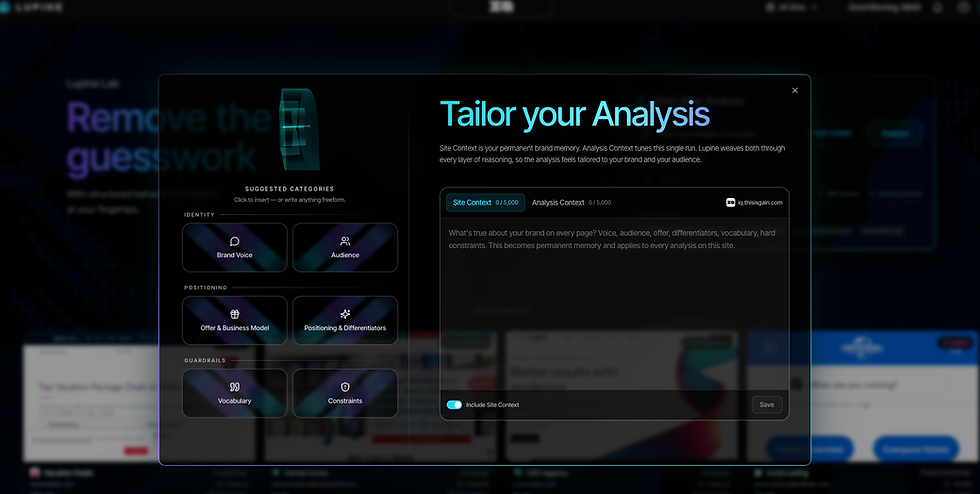
Today we're releasing +Context, a new feature inside Lupine that lets you tell the product what your business reality is before an analysis begins.
Why we built this
Lupine analyses pages well. It identifies friction, surfaces behavioural problems, and suggests experiments grounded in over 15 years of conversion expertise and more than 10,000 experiments. But a recurring theme from our clients was clear: some of the recommendations were directionally right but contextually wrong.
Ideas that didn't account for your KPI, your audience, your compliance rules, or the fact that you'd already tested that exact thing six months ago.
That isn't an intelligence shortcoming. It's a context one.
What +Context does
+Context is a structured input layer that sits before the analysis. Before Lupine begins generating problems, hypotheses, and experiment ideas, you tell it what governs the analysis.
That includes:
Competitor Information
Past Test Results
Performance or Site Data Inputs
Brand Guidelines
Your primary KPI and page goal
Your target audience
Geographic and industry nuances
Constraints and guardrails
Freeform context - anything else that shapes what a good recommendation looks like for your team
You can go light: "Optimise this page for demo requests. Don't touch pricing copy. Focus on the hero and first scroll."
Or you can go deep: full audience segmentation, funnel stage, jurisdictional constraints, brand tone expectations, testability rules. Lupine handles both without forcing you into a lengthy setup.
How Lupine uses it
+Context isn't a label you attach to an analysis. It's a governing layer that changes how Lupine thinks during generation and ranking.
Concretely, it shapes:
Problem definition. What counts as a meaningful issue on this page, given what you're trying to achieve.
Hypothesis relevance. Whether a behavioural mechanism is worth pursuing for this specific business case.
Experiment eligibility. Whether a recommendation is valid given your stated constraints.
A suggestion that would normally surface in a CRO sense may be suppressed if it conflicts with your SEO rules or sits outside your stated KPI. Equally, an idea with moderate generic value may move up the list if it directly serves the page goal you've set.
What changes for you
Before +Context, Lupine was an intelligent outsider looking at your page. It saw what it saw and told you what it thought. After +Context, Lupine operates within your business context. It doesn't need you to filter out recommendations that ignore your brand, your legal team, or your commercial reality. It already knows those things before it starts.
That changes the trust relationship with the product. It reduces false positives and improves experiment relevancy.
Start using +Context
+Context is live now in Lupine. You'll find it in the analysis setup flow.
A few prompts to get you started:
What is the one KPI this page exists to move?
What's off limits? (Compliance copy, pricing, tested areas, seasonal content)
Who is this page actually for?
What would make a recommendation useless for your business, even if it's technically sound?
Lupine is an AI-powered CRO tool built on over 15 years of GAIN's conversion expertise and more than 10,000 real experiments. It generates methodically reasoned, test-ready experimentation ideas to optimise your website.


bottom of page